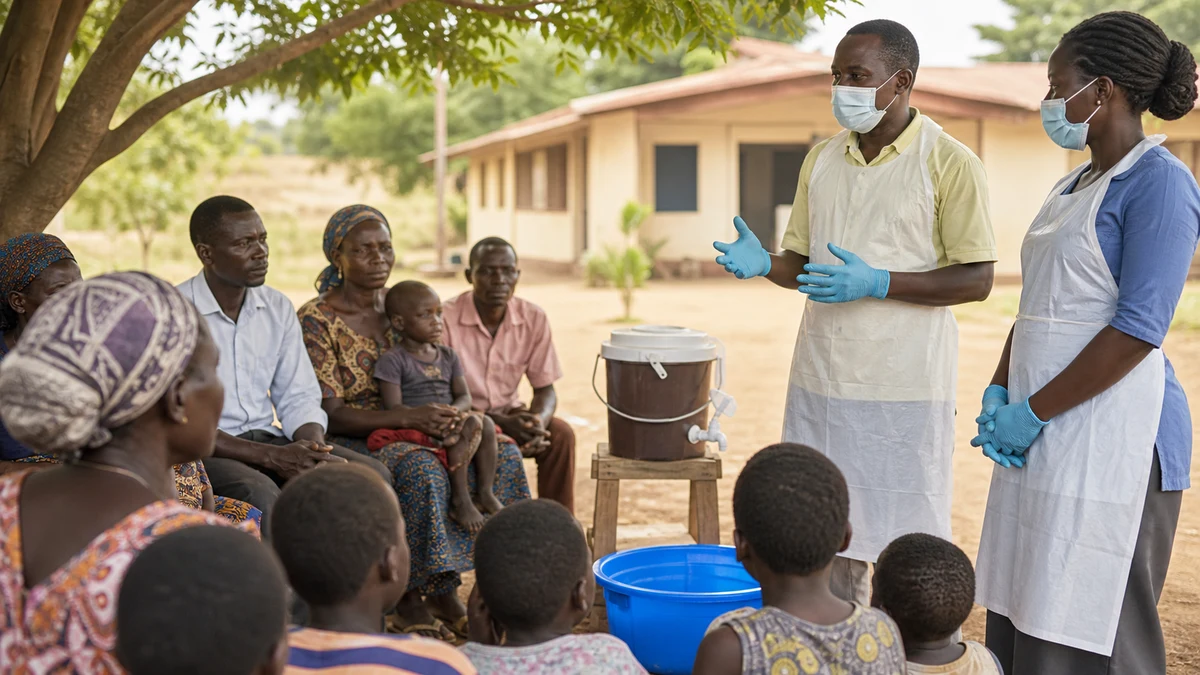
WHO's July 2026 Disease Outbreak News says the Ebola disease outbreak caused by Bundibugyo virus in the Democratic Republic of the Congo and Uganda continues to evolve quickly. The numbers are grave, but the lesson for readers is broader: an outbreak is not only a hospital problem. It moves through families, funerals, travel routes, trust and the conversation between communities and responders.
WHO explains that Bundibugyo is one of the Ebola viruses, and that approved vaccines and treatments for one Ebola virus are not automatically available for every species. That makes the response package especially important: early care, contact tracing, laboratory testing, infection prevention, safe and dignified burials and community engagement. If communication breaks down, the medical response weakens.
Fresh AP reporting from Ituri points to another danger: insecurity and attacks on health facilities or workers can slow the response. If health workers cannot safely reach a village, the virus gets more room. If families believe burial rules ignore dignity or tradition, resistance grows. That means public health has to earn trust, not only issue instructions.
Readers across Africa can take practical steps without becoming specialists. During an Ebola alert, use health ministry and WHO sources rather than anonymous audio messages. If someone returns from an outbreak area and becomes ill, call a health line before moving that person through several clinics. If there is a death, safe burial guidance protects both the family and the wider community.
Public language matters too. Ebola should not be used to shame families, ethnic groups or survivors. People who are ill need care, and people who recover need dignity. When fear becomes louder than facts, symptoms are hidden and tracing becomes harder. Calm information is not softness; it is a control tool.
The practical message is that early care, verified information, contact tracing and safe burial belong together. Not every reader will become a health expert, but everyone can help reliable messages move faster than rumors. In an Ebola outbreak, trust can function like lifesaving infrastructure.